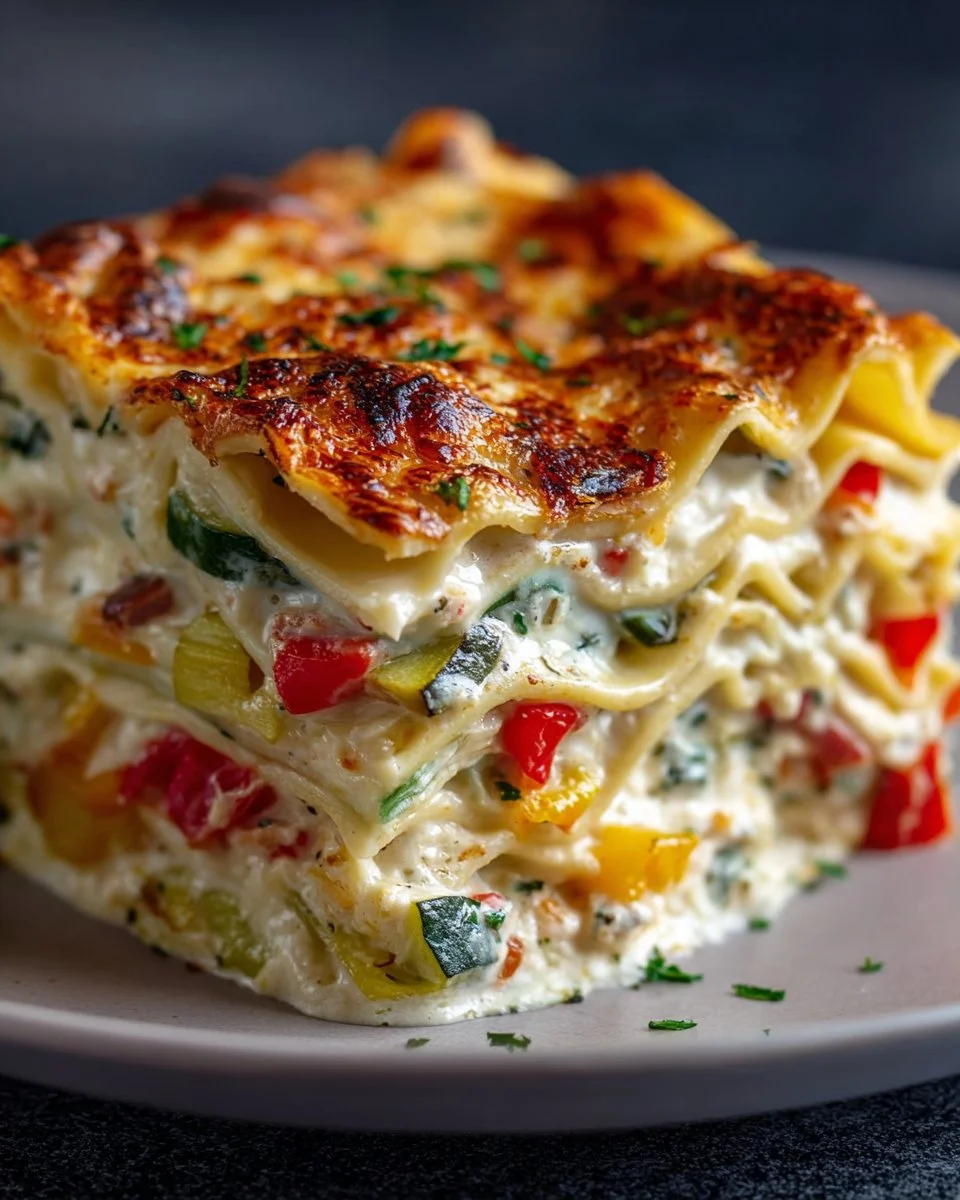
The first bite of this Loaded Veggie White Lasagna feels like a cozy, sunlit kitchen—warm, comforting, and impossibly creamy. A cloud of white sauce coats ribbons of tender pasta and folds into sweet bell peppers, zucchini that still hold a slight bite, and spinach that softens into silky green pockets. Melted mozzarella stretches as you lift a piece, and a gentle hint of nutmeg in the sauce whispers of old-fashioned comfort with a modern vegetable-forward twist.
Aromas of garlic and caramelized onion rise from the pan, mingling with the buttery, nutty scent of a béchamel simmered to silky perfection. Each mouthful balances creaminess and brightness: the ricotta-Parmesan mixture adds tang and body while roasted vegetables give textural contrast. Whether you spoon this lasagna onto a weekend table or tuck it into a weeknight dinner plan, it arrives like a hug—satisfying, elegant, and full of flavor. If you like indulgent, vegetable-rich dishes like these, you might enjoy my playful banana white cake truffles for dessert after dinner.
Why You’ll Love This Loaded Veggie White Lasagna
This lasagna shines because it pairs classic, luscious white sauce with bold, crisp vegetables. The béchamel brings a velvety base that lets the freshness of bell peppers and zucchini sing without overpowering them. Ricotta, Parmesan, and egg bind the filling into a creamy layer that contrasts beautifully with the lightly chewy lasagna noodles and the bubbling golden mozzarella on top.
Serve it for family dinners, potlucks, or a relaxed Sunday supper when you want something comforting but not heavy. Vegetarians love it as a centerpiece that feels celebratory, and cooks love it because it uses pantry staples and frozen spinach for convenience. It stands out because it avoids heavy tomato tang, instead leaning on buttery richness and herb-free simplicity so the vegetables and dairy shine through.
Preparation Phase & Tools to Use
Having the right tools makes this recipe effortless and ensures a perfect texture.
- Large saucepan: Use this to whisk and simmer the white sauce. A heavy-bottomed pan prevents scorching and helps the sauce thicken evenly.
- Large skillet: Sauté the vegetables in one pan so they soften quickly and develop color without steaming.
- Whisk: Essential for smooth, lump-free béchamel as you add milk to the roux.
- Mixing bowl: Combine ricotta, Parmesan, egg, and vegetables easily and evenly.
- 9×13-inch baking dish: Standard size for even layering and reliable baking time.
- Aluminum foil: Locks moisture during the first part of baking so the interior heats through.
- Colander and tongs: For draining noodles and handling them without tearing.
Practical preparation tips:
- Measure and prepare all ingredients before you start the sauce; béchamel needs attention once it begins.
- Squeeze thawed spinach thoroughly in a clean dish towel or handfuls to remove excess water—this prevents a watery lasagna.
- Chop vegetables in uniform sizes so they cook at the same rate and provide consistent texture in every bite.
Ingredients for Loaded Veggie White Lasagna
- 1/2 cup (113g) butter
- 1/2 cup (57g) all-purpose flour
- 4 cups (946ml) milk
- 1/4 teaspoon nutmeg
- 1/2 teaspoon salt (for the sauce)
- 1/4 teaspoon black pepper (for the sauce)
- 1 tablespoon olive oil
- 1 medium onion, chopped
- 2 cloves garlic, minced
- 1 red bell pepper, chopped
- 1 yellow bell pepper, chopped
- 1 medium zucchini, chopped
- 1 (10-ounce) package (283g) frozen spinach, thawed and squeezed dry
- 1 (15-ounce) container (425g) ricotta cheese
- 1/2 cup (50g) grated Parmesan cheese
- 1 large egg, lightly beaten
- 1/4 teaspoon salt (for the ricotta mixture)
- 1/4 teaspoon black pepper (for the ricotta mixture)
- 9 lasagna noodles
- 3 cups (336g) shredded mozzarella cheese
Key ingredients and substitutions:
- Butter and flour form a roux—the base of the white sauce. For a lighter version, swap half the butter for olive oil; for gluten-free, use a gluten-free flour blend.
- Milk creates the silky béchamel; whole milk yields the creamiest result, but 2% works fine. For a richer sauce, use half-and-half for half the milk.
- Ricotta adds creaminess and structure. Substitute part of the ricotta with cottage cheese (blended for smoothness) for a lighter texture.
- Frozen spinach is convenient and consistent; fresh spinach works too—sauté 6–8 cups fresh spinach until wilted and then squeeze dry.
- Mozzarella browns beautifully; mix part fresh mozzarella with shredded for a gooey, rustic top.
- Parmesan adds umami. Pecorino Romano gives sharper flavor if you like bolder cheese notes.
How to Make Loaded Veggie White Lasagna
Follow these clear, step-by-step instructions for a beautifully layered lasagna.
-
Prepare the white sauce (béchamel).
- Melt 1/2 cup (113g) butter in a medium saucepan over medium heat.
- Whisk in 1/2 cup (57g) all-purpose flour and cook for 1–2 minutes until the mixture becomes smooth and lightly golden (this removes the raw flour taste).
- Gradually whisk in 4 cups (946ml) milk, a little at a time, until fully smooth.
- Bring to a gentle simmer while stirring constantly. Reduce heat and simmer for 5–7 minutes until the sauce thickens and coats the back of a spoon.
- Stir in 1/4 teaspoon nutmeg, 1/2 teaspoon salt, and 1/4 teaspoon black pepper. Remove from heat and set aside.
Tip: If the sauce gets too thick, whisk in a splash more milk; if it’s lumpy, strain quickly or vigorously whisk over low heat.
-
Prepare the vegetable filling.
- Heat 1 tablespoon olive oil in a large skillet over medium heat.
- Add 1 medium chopped onion and cook until softened and translucent, about 5 minutes.
- Add 2 cloves minced garlic and cook for 1 minute more until fragrant.
- Add 1 chopped red bell pepper, 1 chopped yellow bell pepper, and 1 chopped medium zucchini. Sauté until the vegetables are tender-crisp, about 5–7 minutes, so they retain texture.
- Stir in 1 (10-ounce) package thawed, squeezed-dry spinach and season with 1/4 teaspoon salt and 1/4 teaspoon black pepper. Remove from heat and let cool slightly.
Tip: Cook the vegetables until they show some browning for deeper flavor; avoid overcooking to prevent a mushy filling.
-
Make the ricotta mixture.
- In a large bowl, combine 1 (15-ounce) container ricotta, 1/2 cup (50g) grated Parmesan, and 1 large lightly beaten egg.
- Stir in the cooled vegetable mixture until evenly distributed.
Tip: If the ricotta feels grainy, briefly whisk or beat to smooth before folding in vegetables.
-
Cook the lasagna noodles.
- Cook 9 lasagna noodles according to package directions until al dente. Drain and rinse with cold water to stop cooking and prevent sticking.
Tip: Brush a little olive oil on the noodles if stacking them to avoid tears.
- Cook 9 lasagna noodles according to package directions until al dente. Drain and rinse with cold water to stop cooking and prevent sticking.
-
Assemble the lasagna.
- Preheat oven to 375°F (190°C).
- Spread a thin layer of white sauce in the bottom of a 9×13-inch baking dish (this prevents noodles from sticking).
- Layer 3 lasagna noodles over the sauce.
- Spread half of the ricotta-vegetable filling over the noodles and sprinkle with 1 cup (112g) mozzarella.
- Pour a thin layer of white sauce over the mozzarella.
- Add another layer of 3 noodles, spread the remaining vegetable filling, sprinkle 1 cup (112g) mozzarella, and add more sauce.
- Top with the final 3 noodles and pour the remaining white sauce evenly over the top. Sprinkle with the remaining 1 cup (112g) mozzarella.
Tip: Gently press layers down to remove air pockets, but don’t squeeze out the filling.
-
Bake and rest.
- Cover the dish tightly with aluminum foil and bake for 25 minutes.
- Remove the foil and bake for an additional 20–25 minutes, until the cheese is melted, bubbly, and beginning to golden.
- Let the lasagna stand for 10–15 minutes before slicing so the layers set and serve clean slices.
Tip: For a golden crust, broil for the last 1–2 minutes while watching closely to avoid burning.
Chef’s Notes & Helpful Tips
Make-ahead tips:
- Assemble the lasagna up to the point of baking, cover tightly, and refrigerate up to 24 hours. Add an extra 5–10 minutes to baking time if cold from the fridge.
- For freezing, assemble and wrap tightly with plastic wrap and foil. Freeze up to 3 months. Thaw overnight in the refrigerator before baking; bake covered for 35–45 minutes, then uncovered until bubbly.
Cooking alternatives:
- Air fryer: Use a small, oven-safe pan sized for your air fryer. Reduce initial covered time and watch closely—air fryers brown faster.
- Slow cooker: Layer ingredients in a 6-quart slow cooker. Cook on low for 3–4 hours or until heated through and cheese melts; avoid lifting the lid frequently.
- Grill: Place covered cast-iron or grill-safe baking dish on indirect heat. Maintain moderate temperature and check doneness as you would in an oven.
Customization ideas:
- Add mushrooms, eggplant, or thinly sliced roasted butternut squash for earthiness.
- Stir in fresh herbs like basil or thyme into the ricotta mixture for a fragrant lift.
- For a spicy kick, add crushed red pepper flakes to the vegetable sauté.
- Make it vegan by replacing butter with vegan spread, milk with unsweetened plant milk, ricotta with a tofu or cashew-based ricotta, and vegan mozzarella.
Common Mistakes to Avoid
- Not squeezing the spinach dry: Excess water makes the lasagna watery. Press thawed spinach in a towel or squeeze in your hands until it feels dry.
- Burning the roux: Flour and butter cook quickly; keep stirring and watch the color. If it browns too much, it alters the sauce flavor.
- Overcooking vegetables: Soft, mushy veggies muddle the texture. Aim for tender-crisp so they keep shape in layers.
- Skipping the rest time: Cutting immediately causes the lasagna to fall apart. Letting it rest allows the layers to set and makes neater slices.
- Using too much sauce at once: A thin base and measured layers prevent a soggy top or edges. Distribute sauce evenly so noodles soften but don’t drown.
What to Serve With Loaded Veggie White Lasagna
- Simple green salad with lemon vinaigrette: A bright salad cuts through the richness and refreshes the palate.
- Garlic-roasted broccoli: Adds a roasted, slightly charred contrast and more green veg on the plate.
- Crispy oven-roasted potatoes: A crunchy, herby side for guests who adore texture contrasts.
- Warm crusty bread or focaccia: Perfect for sopping up leftover white sauce and cheese.
- Marinated olives and pickled vegetables: Small acidic bites help balance creaminess and add a Mediterranean edge.
- Light citrus sorbet for dessert: A palate-cleansing finish after a rich, cheesy main.
- A chilled glass of dry white wine (Pinot Grigio or Sauvignon Blanc): Its acidity complements the lasagna’s dairy richness.
- Roasted beet and arugula salad with balsamic drizzle: Peppery arugula and sweet beets provide a sophisticated counterpoint.
Storage & Reheating Instructions
Fridge:
- Store covered with plastic wrap or in an airtight container for up to 4 days.
- Reheat individual slices in the oven at 350°F (175°C) for 10–15 minutes, or until heated through. Cover loosely with foil to prevent drying.
Freezer:
- Freeze whole or in portions for up to 3 months. Wrap tightly with plastic wrap and foil or use a freezer-safe container.
- Thaw overnight in the fridge before reheating. Reheat covered at 350°F (175°C) for 30–40 minutes for a whole dish, or 20–30 minutes for portions.
Microwave:
- For single servings, microwave on medium power in 1-minute bursts, stirring or rotating if possible, until heated through. Finish with 30 seconds to 1 minute on high to rekindle the cheese’s melt.
Tips:
- Add a splash of milk or a spoonful of sauce when reheating to restore creaminess.
- If the top browns too quickly, cover with foil during reheating.
Estimated Nutrition Information
Approximate per serving (recipe yields 8 servings):
- Calories: ~500–600 kcal
- Fat: ~30–35 g
- Saturated Fat: ~18–22 g
- Carbohydrates: ~35–45 g
- Protein: ~20–25 g
- Fiber: ~3–5 g
- Sodium: ~600–900 mg
Disclaimer: These values are rough estimates and depend on exact brands, portion sizes, and substitutions. For precise nutrition, calculate using the specific products you use.
FAQs
Q: Can I use no-boil lasagna noodles instead of cooking them first?
A: Yes. No-boil noodles work well and absorb the sauce as they bake. When using no-boil noodles, ensure your sauce is slightly thinner so the noodles hydrate fully—add about 1/4 to 1/2 cup extra milk to the béchamel. You may also want to increase the covered baking time by 5–10 minutes.
Q: How do I make the white sauce lump-free?
A: Whisk continuously while adding milk gradually to the roux (butter + flour). Start with a small amount to form a smooth paste, then add the rest in a steady stream. Keep the heat moderate; too high heat can cause lumps. If lumps appear, remove from heat and whisk briskly, or strain through a fine-mesh sieve.
Q: Can I prepare this lasagna ahead for a crowd?
A: Absolutely. Assemble the lasagna the day before, cover tightly, and refrigerate. Bring it to room temperature for 30 minutes while the oven preheats, then bake according to instructions, adding a few extra minutes if still quite cold. This makes hosting much more relaxed.
Q: My lasagna came out watery—what did I do wrong?
A: Watery lasagna often results from insufficiently drained spinach, overcooked vegetables releasing moisture, or under-thickened béchamel. Always squeeze spinach dry, cook vegetables until lightly crisp, and simmer the white sauce until it coats a spoon. Letting the lasagna rest also helps excess moisture redistribute.
Q: How can I boost protein or make it heartier?
A: Add cooked, shredded chicken or Italian sausage (crumbled and browned) to the vegetable-ricotta layer. For a vegetarian protein boost, fold in cooked lentils or a cup of white beans mashed slightly into the ricotta mixture—these integrate well and add satisfying heft without changing the lasagna’s character.
Q: Can I freeze individual portions for quick lunches?
A: Yes. Portion into airtight, freezer-safe containers and freeze up to 3 months. Reheat from frozen in the oven at 350°F (175°C) for about 25–35 minutes (covered), then uncover to heat until bubbly, or microwave thawed portions for convenience.
Conclusion
This Loaded Veggie White Lasagna rewards patient hands and a little time on the stovetop with layers of silky béchamel, vibrant vegetables, and gooey, golden cheese—comfort that feels both nourishing and celebratory. Whether you want to impress guests or simply curl up with a dish that tastes like home, this lasagna delivers warmth, texture, and bright vegetable notes in every forkful. For another take on vegetables baked in a creamy white sauce, see this lovely version at Vegetable Lasagna with White Sauce – It’s a Veg World After All®.
Print
Loaded Veggie White Lasagna
- Prep Time: 20 minutes
- Cook Time: 55 minutes
- Total Time: 75 minutes
- Yield: 8 servings 1x
- Category: Main Course
- Method: Baking
- Cuisine: Italian
- Diet: Vegetarian
Description
Creamy and comforting lasagna layered with béchamel sauce, vibrant vegetables, and gooey mozzarella.
Ingredients
- 1/2 cup (113g) butter
- 1/2 cup (57g) all-purpose flour
- 4 cups (946ml) milk
- 1/4 teaspoon nutmeg
- 1/2 teaspoon salt (for the sauce)
- 1/4 teaspoon black pepper (for the sauce)
- 1 tablespoon olive oil
- 1 medium onion, chopped
- 2 cloves garlic, minced
- 1 red bell pepper, chopped
- 1 yellow bell pepper, chopped
- 1 medium zucchini, chopped
- 1 (10-ounce) package (283g) frozen spinach, thawed and squeezed dry
- 1 (15-ounce) container (425g) ricotta cheese
- 1/2 cup (50g) grated Parmesan cheese
- 1 large egg, lightly beaten
- 1/4 teaspoon salt (for the ricotta mixture)
- 1/4 teaspoon black pepper (for the ricotta mixture)
- 9 lasagna noodles
- 3 cups (336g) shredded mozzarella cheese
Instructions
- Melt 1/2 cup (113g) butter in a medium saucepan over medium heat.
- Whisk in 1/2 cup (57g) all-purpose flour and cook for 1–2 minutes until the mixture becomes smooth and lightly golden.
- Gradually whisk in 4 cups (946ml) milk until fully smooth.
- Bring to a gentle simmer while stirring constantly, then reduce heat and simmer for 5–7 minutes until the sauce thickens.
- Stir in 1/4 teaspoon nutmeg, 1/2 teaspoon salt, and 1/4 teaspoon black pepper. Remove from heat and set aside.
- Heat 1 tablespoon olive oil in a large skillet over medium heat.
- Add 1 medium chopped onion and cook until softened, about 5 minutes.
- Add 2 cloves minced garlic and cook for 1 minute.
- Add chopped red and yellow bell peppers and zucchini. Sauté until tender-crisp, about 5–7 minutes.
- Stir in thawed spinach and season with 1/4 teaspoon salt and 1/4 teaspoon black pepper. Let cool slightly.
- In a large bowl, combine ricotta, 1/2 cup (50g) Parmesan, and 1 large beaten egg.
- Stir in the cooled vegetable mixture.
- Cook lasagna noodles according to package directions; drain and rinse with cold water.
- Preheat oven to 375°F (190°C).
- Spread a thin layer of sauce in a 9×13-inch baking dish.
- Layer 3 noodles, then half of the filling, and sprinkle with 1 cup (112g) mozzarella. Pour a thin layer of sauce.
- Repeat the layers, finishing with remaining noodles and sauce; top with 1 cup (112g) mozzarella.
- Cover with foil and bake for 25 minutes; remove foil and bake for another 20–25 minutes until golden.
- Let stand for 10–15 minutes before slicing.
Notes
Make ahead and refrigerate for up to 24 hours before baking. Can be frozen for up to 3 months.
Nutrition
- Serving Size: 1 serving
- Calories: 550
- Sugar: 5g
- Sodium: 800mg
- Fat: 30g
- Saturated Fat: 18g
- Unsaturated Fat: 8g
- Trans Fat: 0g
- Carbohydrates: 45g
- Fiber: 4g
- Protein: 25g
- Cholesterol: 50mg